
+44 (0)1209 316041 | sales@gravitymining.com
The Loben Hydrocyclone Range
LOBEN: Why Fine Cut Size Matters
Loben, meaning "tin slimes" in Cornish, is our specialist range of small-diameter hydrocyclones, purpose-built for the finest separations in modern mineral processing.
Named for the very material it was designed to master, Loben was born from a decade of fine-mineral processing in Cornwall's tin country. It represents everything Gravity Mining has learned about separation at the finest scales. Fine particles, slimes, are the enemy of efficient mineral recovery. They blind screens, dilute concentrates, clog flotation cells and drag down metallurgical performance. A cyclone that can remove them without loss of valuable ore is worth its weight in gold. Loben does exactly that, with cut points down to 6–8 microns.
Small-diameter cyclones make the sharpest cuts. But a single cyclone can't carry plant flow. That's where the Loben range solves the problem — offering everything from individual 25mm and 50mm cyclones through to multi-cyclone mushroom assemblies, so you can have ultra-fine cuts at production scale without compromise.
The Range at a Glance
Loben range

Diameter:
Cone angle:
Spigot sizes:
Vortex finder:
Free vortex height:
Operating pressure:
Capacity:
D50c (indicative):
Applications:
GCH50NL

50mm
15°
4, 6, 8, 12mm
16mm
250mm
0.5–3.5 bar
1.7–4.5 m³/hr
9–18µm
De-slime
De-water
GCH25NL

25mm
15°
2, 3, 4, 5, 6mm
8.5mm
125mm
0.5–3.5 bar
0.6–2.1 m³/hr
8–11µm
De-slime
De-water
GCH25FL

25mm
5°
2, 3, 4, 5, 6mm
8.5mm
300mm
0.5–3.5 bar
0.6–2.1 m³/hr
6–9µm
De-slime
De-water
Solids removal
GCH25SL

25mm
90°
4mm
8.5mm
30–45mm
0.5–3.5 bar
0.6–2.1 m³/hr
30–80µm
Slurry preparation
Features and Benefits
Every detail of the Loben cyclone is engineered for performance and longevity. Hover over each numbered feature to discover how.
Inlet separation concept
Minimises vortex disruption at cyclone entry for sharp, consistent cuts.

-
Smooth reduction in inlet area to minimise entry turbulence
-
Longer inlet separation to reduce vortex reduction at cyclone entrt

Pop-out spigot
Simple adjustment of flow ratio and in-situ blockage clearance.

-
Simple adjustment of spigot size and flow ratio
-
Easy in-situ blockage clearance
Vertical feed
Minimises the cyclone footprint while maximising density in assemblies.

-
Compact design with minimal diameter
-
Maximum density of cyclones in assemblies
Manufactured in PU
Outstanding chemical and abrasion resistance
-
Outstanding resistance to abrasion and impact from fine mineral slurries
-
Broad chemical resistance: acids, alkalis, organic solvents
Features and Benefits
Every detail of the Loben cyclone is engineered for performance and longevity. Hover over each numbered feature to discover how.
Overflow Adapter
Redirects the flow, clamps the feed to the cyclone body and provides an anti siphon feature.

-
Smooth reduction in inlet area to minimise entry turbulence
-
Longer inlet separation to reduce vortex reduction at cyclone entrt
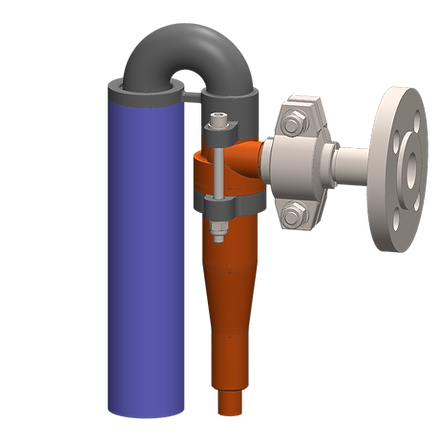
Feed Adapter
Groove connector, minimum inlet turbulence, safe and secure under high pressure with straightforward connection to your system.

-
Compact design with minimal diameter
-
Maximum density of cyclones in assemblies
Spigot Set
Optional spigot set offers 6 options of flow ratio.

-
6 sizes for simple adjustment of flow ratio
Mushroom Assemblies
Named because of their appearance appearance these assemblies can be treated as a single high-capacity unit with single point connections for feed, underflow and overflow.
GCMA10x50N

Cyclone: GCH50NL
Number of cyclones: 10
Assembly nominal diameter: 345mm
Capacity: 17 - 45m³/hr
Nominal cut size: 9 - 18µm
GCMA18x25N

Cyclone: GCH25NL
Number of cyclones: 18
Assembly nominal diameter: 310mm
Capacity: 11 - 38m³/hr
Nominal cut size: 7.5 - 10.5µm
Mushroom Radials
We can design and manufacture mushroom radial assemblies tailored to your performance and capacity requirements.

-
Compact size
-
High capacity with no change in cut performance
-
Single point connection to feed, overflow and underflow
-
Isolation valves for hassle free maintenance
-
Integral pressure gauge
Operating principles

A vortex is created
A vortex is created in the cylindrical body by the tangential entry of fluid under pressure through the feed inlet.
Heavier solids migrate to the wall
The vortex speed increases as it travels down the conical shape of the cyclone, and heavier solids migrate to the sides by the action of centripetal force.
Solids exit at the spigot
When the solids reach the sides, they are slowed by drag forces against the wall and slide down to be ejected through the spigot to the underflow.
Fines rise to the overflow
Air is drawn in through the spigot, generating an air column in the centre of the cyclone. A secondary vortex forms around this air column, causing liquid and fine particles to rise to be ejected to the overflow via the vortex finder. This provides another opportunity for solid particles to transfer to the primary vortex to eventually exit via the underflow.
The Recovery Curve

Particle size
Increasing particle size increases the probability that a particle will report to the underflow and this probability is typically presented as a recovery curve. The cyclonic action will direct coarser particles to the underflow. Finer particles, however, will remain in suspension and report with the fluid either to the underflow or overflow as dictated by the flow ratio.
Actual and Corrected Recovery
The actual recovery curve includes the fine particles reporting to the underflow with the fluid.
The corrected recovery curve corrects for this and only includes particles that have been directed to the underflow by the cyclonic action.
Cut Size
The “cut size” of a hydrocyclone is typically identified as the point when the corrected recovery curve is at 50%, i.e. there is a 50% probability that a particle entering the cyclone will be caused to report to the underflow by the cyclonic action. This is identified by the value D50c. Actual recovery at this point is likely to be higher as it will include material reporting to the underflow with the fluid.
Influencing factors
Key factors influencing cut size
-
Cyclone diameter
-
Particle specific gravity
-
Pulp density
-
Working pressure
Use the Calculator
Our cyclone calculation tool is free, online, and covers all options in the Loben range. Enter your pressure, pulp density, solids SG and feed PSD and see the predicted cut size, solids recovery and stream-by-stream results in seconds.
What you input:
-
Operating pressure (bar)
-
Feed solids specific gravity
-
Pulp density (% w/w)
-
Feed particle size distribution (D10, D50, D90)
What you get:
-
Corrected and actual cut size (D50c and D50a)
-
Overall solids recovery to underflow (%)
-
Flow rates and densities for each stream
-
Recovery curves and cumulative PSDs